Why Equipment Quality Matters
Consumer equipment doesn’t work for professional restoration. Period.
That shop-vac from Home Depot? Pulls maybe 6 gallons per minute. Our truck-mounted extractors? 200+ gallons per minute. That’s not a small difference. That’s the difference between drying a flooded basement in 6 hours versus 3 days.
Professional equipment saves your property by:
Removing water faster, which stops additional damage. Drying structures completely, which prevents mold growth. Finding hidden moisture, which prevents problems later. Creating proper airflow patterns, which speeds drying scientifically. Filtering air completely, which protects health during restoration.
Speed matters in restoration. But equipment capability determines how fast we can actually work. The best technician in the world with inadequate equipment will get poor results. Proper equipment in trained hands? That saves properties.
Water Extraction Equipment
Water extraction is where restoration starts. Get the water out fast or everything else fails.
Truck-Mounted Extractors
Our primary extraction equipment is truck-mounted. That means the power source and waste tanks are in our trucks, with hoses running into your property.
Why truck-mounted matters: More power than any portable unit. Massive waste capacity so we’re not constantly emptying tanks. Heated extraction that works better than cold. And honestly, these machines are built like tanks. Run continuously for hours without overheating.
Lee Wallender from The Spruce explains that extraction capacity determines how fast water removal happens. Every minute water sits in carpet or padding, it’s wicking into walls, subflooring, and adjacent materials. Fast extraction limits that spread.
We extract until we’re pulling almost nothing. Not until we get tired. Not until it “looks good enough.” Until scientific measurements show we’ve removed all the extractable water. Then drying equipment takes over.
Portable Extractors
Truck-mounted equipment can’t reach everywhere. Upstairs rooms. Tight spaces. Areas where we can’t run hoses.
That’s where portable extractors come in. These are still professional-grade, not consumer equipment. Pull 50-100 gallons per minute. Powerful enough for serious water removal. Portable enough to get anywhere in a building.
Something that can happen is a finished basement floods. Furniture everywhere. Tight spaces. Multiple rooms. We use portable extractors to navigate around obstacles and extract water from areas the truck-mounted equipment can’t reach effectively.
Dehumidification Equipment
Extraction removes standing water. Dehumidification removes moisture from materials and air.
Commercial Dehumidifiers
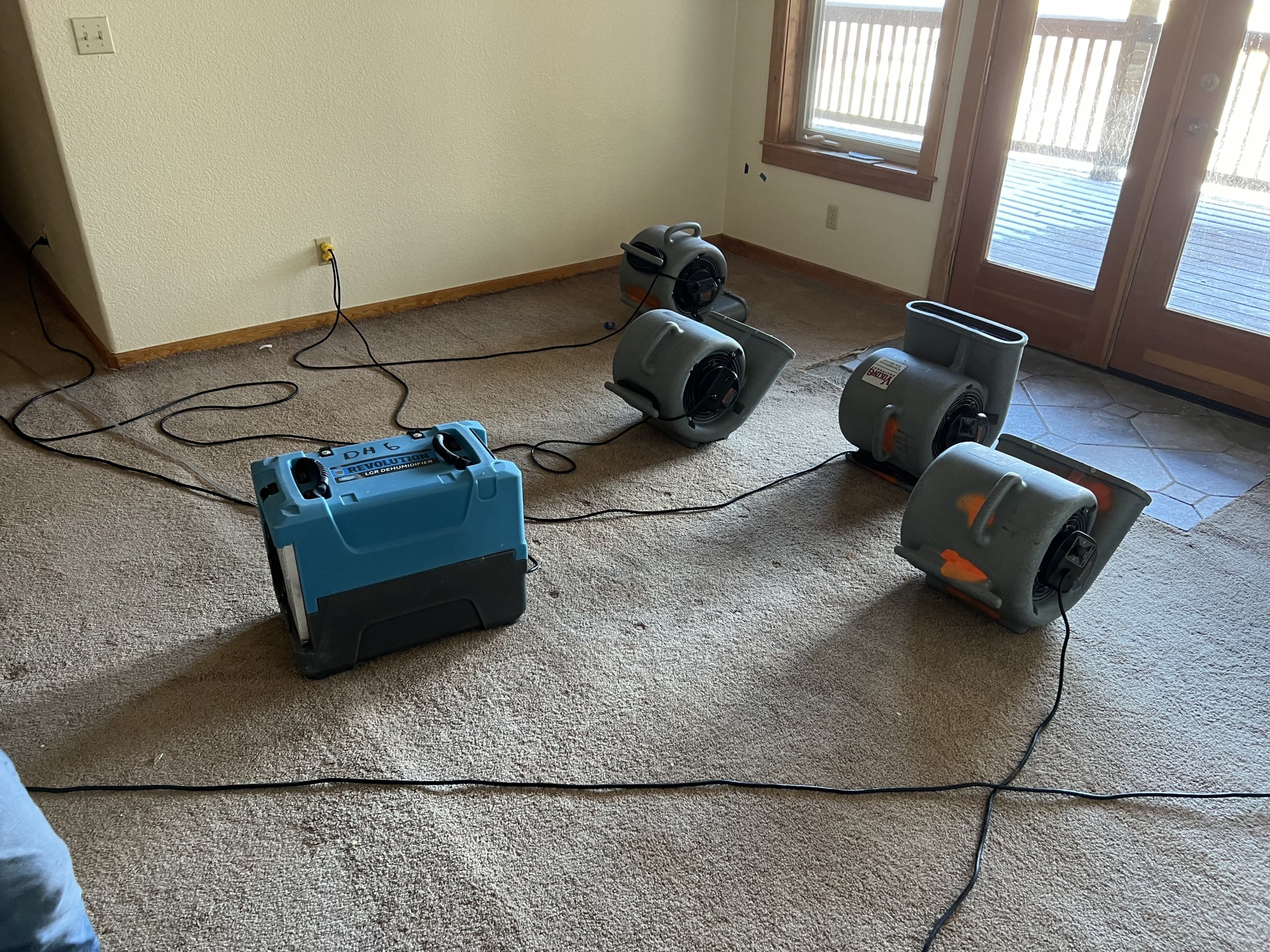
These aren’t the little units you buy at Target for your musty closet. Commercial dehumidifiers remove 150-250 pints of moisture per day. Consumer units? Maybe 50 pints if you’re lucky.
How professional dehumidifiers work:
Pull massive volumes of air across refrigerant coils. Condense moisture out of that air. Collect it in tanks or pump it outside. Repeat continuously until humidity drops to target levels.
Tim Carter from Ask the Builder points out that dehumidification isn’t just about removing moisture from air—it’s about creating the proper vapor pressure gradient so moisture moves from materials into the air where dehumidifiers can capture it.
We place dehumidifiers strategically based on airflow patterns. Not randomly. The goal is creating efficient moisture removal throughout the affected space. Dehumidifier placement follows physics, not guesswork.
Desiccant Dehumidifiers
Refrigerant dehumidifiers work great in most conditions. But when it’s cold—like mountain properties in winter—refrigerant units lose efficiency.
Desiccant dehumidifiers use absorbent materials instead of refrigerant coils. Work effectively in any temperature. Critical for winter restoration work in Colorado’s mountains where temperatures in damaged buildings might be near freezing.
These units are specialized. Most restoration companies don’t own them because they’re expensive. We do because mountain restoration requires them.
Air Movement Equipment
Moving air is what makes drying happen. Dehumidifiers lower humidity. Air movers create the airflow that pulls moisture from materials.
High-Velocity Air Movers
These look like big fans but they’re way more sophisticated. Designed specifically to create airflow patterns that promote drying.
Professional air movers move 2,000-3,000 cubic feet per minute. Consumer fans? Maybe 1,000 CFM. That difference matters enormously when you’re trying to dry wet drywall, insulation, or structural lumber.
Air mover placement follows patterns:
Direct air across wet surfaces. Create circulation throughout the space. Work with dehumidifier intake locations. Prevent dead zones where air doesn’t move. And honestly, this takes training to do correctly. Random fan placement doesn’t work.
What I’ve seen happen is homeowners try drying with box fans. They point fans at wet areas. Nothing’s drying. Why? Because they’re just moving humid air around. They’re not creating the proper conditions for moisture to evaporate and be captured.
We position air movers to maximize drying efficiency. Sometimes that means pointing them away from wet surfaces to create circulation patterns. Counterintuitive, but it works because airflow physics aren’t always obvious.
Moisture Detection Equipment
You can’t dry what you can’t measure. Moisture meters and thermal imaging cameras find hidden water.
Moisture Meters
Two types: pin meters and non-invasive meters.
Pin meters use small probes that penetrate material surfaces. Give precise readings of moisture content in wood, drywall, concrete. When we say “this drywall is at 28% moisture content,” that’s from pin meter readings.
Non-invasive meters scan surfaces without penetration. Great for quick surveys of large areas. Help us map moisture patterns without putting holes in everything.
Building materials have different moisture content standards. Dry wood is usually 6-12% depending on species. Wet wood reads 20%+. Saturated wood hits 30-40%. These numbers guide our drying strategy.
Thermal Imaging Cameras
These are game-changers for finding hidden moisture.
Water is cooler than surrounding materials. Thermal cameras show temperature differences as color patterns. That cold spot on your ceiling? Water hiding in insulation. That blue area on the wall? Moisture behind the drywall.
Thermal imaging finds problems invisible to the eye. Water inside walls. Moisture in ceiling cavities. Hidden leaks that haven’t caused visible damage yet. This technology prevents us from missing moisture that would cause mold weeks later.
A common thing seen in the industry is restoration companies missing hidden moisture. They dry what they can see. Leave moisture in cavities and behind surfaces. Three weeks later, mold everywhere. Customer calls saying “you didn’t dry it properly.” And they’re right—because that company didn’t have the equipment to find hidden moisture.
Air Filtration and Purification
When we’re working, we’re disturbing contaminants. Dust, mold spores, soot particles, bacteria. Air filtration protects everyone.
HEPA Air Scrubbers
HEPA filters capture 99.97% of particles 0.3 microns or larger. That’s smaller than most mold spores. Smaller than many bacteria.
Air scrubbers run continuously during restoration work. Pull air through filters repeatedly. Each pass removes more contaminants. By the time we’re done, air quality is better than before the damage happened.
These units move 300-2,000 CFM depending on size. We select capacity based on room size and contamination level. Light water damage might need one unit. Sewage backup requires multiple units plus negative air pressure.
Negative Air Machines
These create negative pressure in containment areas. Air flows in but doesn’t flow out except through filters.
Why this matters: When we’re removing mold or working in contaminated areas, we don’t want spores spreading to clean areas. Negative pressure keeps contamination contained. Air in the work area gets filtered before it goes anywhere else.
Norm Abram from This Old House has demonstrated this principle repeatedly: Containment and dust control aren’t just about keeping things clean. They’re about preventing cross-contamination that creates additional problems.
Specialized Cleaning Equipment
Different damages require different cleaning approaches and equipment.
Ozone Generators
Ozone eliminates odors at the molecular level. Not covering them up. Actually destroying the molecules that cause smell.
Fire smoke odor. Sewage smell. Dead animal odor. Ozone treats all of them. But it requires proper protocols. Ozone is toxic to people and pets. We evacuate the space, run ozone generators, then ventilate completely before anyone returns.
Something that can happen is companies trying to eliminate smoke odor without ozone treatment. They clean surfaces, paint, use air fresheners. Three months later the smell returns. Because smoke molecules embedded deep in materials weren’t eliminated—they were just temporarily covered up.
Thermal Foggers
These create fog that penetrates porous materials. Carry deodorizing chemicals deep into fabrics, wood, drywall. Reach places surface cleaning can’t touch.
Thermal fogging complements ozone treatment for severe odor situations. Together they eliminate smells that seemed permanent.
Specialized Cleaning Solutions
We don’t use generic cleaning products. Every situation requires specific chemical solutions.
Soot from protein fires needs different cleaners than synthetic soot. Mold requires EPA-registered antimicrobials. Sewage contamination requires hospital-grade disinfectants. Using wrong products causes more damage.
Our trucks stock dozens of specialized cleaning solutions. Surfactants for different soil types. pH-specific cleaners for different materials. Disinfectants rated for different pathogens. And solvents for different residues.
Equipment Maintenance
Professional equipment only works if it’s maintained properly.
Our Maintenance Schedule:
Daily cleaning and inspection after each job. Weekly detailed maintenance checks. Monthly professional servicing. Annual calibration of moisture meters and thermal cameras. Immediate repair of any issues.
Equipment failures during restoration jobs are unacceptable. When your basement is flooded, our equipment needs to work perfectly. That requires constant maintenance.
What I’ve seen in the industry is companies running equipment until it breaks, then trying to fix it. That’s backwards. We maintain equipment aggressively so breakdowns don’t happen during your emergency.
Why We Invest in Top Equipment
Professional restoration equipment is expensive. Really expensive.
A single truck-mounted extractor costs $30,000+. Commercial dehumidifiers run $2,000-5,000 each. Thermal cameras are $8,000-15,000. Air scrubbers $1,500-3,000. We have multiple units of everything because we often work several jobs simultaneously.
Why invest this much in equipment? Because proper equipment produces proper results.
Your property deserves professional-grade restoration. Your insurance company expects industry-standard equipment. And honestly, we take pride in using the best tools available to save your property.
Equipment That Makes Us Different
Most restoration companies have basic water extraction and drying equipment. That’s standard.
What separates professional operations from basic companies:
We own specialized equipment others rent:
Desiccant dehumidifiers for cold-weather work. Multiple thermal imaging cameras so every technician has one. Truck-mounted extraction in every vehicle. Professional air scrubbers, not consumer air purifiers. Specialized cleaning equipment for different contamination types.
When you call 303-816-0068, we show up with everything needed already in our trucks. Not making additional trips. Not renting equipment. Everything’s here, maintained, and ready.
Equipment Training Requirements
Owning equipment isn’t enough. Knowing how to use it properly is what matters.
Every technician receives training on:
Proper equipment operation. Scientific placement strategies. Moisture monitoring protocols. When to use which equipment. Maintenance procedures. And safety requirements for each piece of equipment.
IICRC certification includes equipment training. But we go beyond minimum requirements. Manufacturer training on new equipment. Hands-on practice. Supervised use until proficiency is demonstrated.
The Science Behind Equipment Selection
We don’t just throw equipment at problems. We calculate what’s needed.
Scientific drying calculations determine:
How many dehumidifiers for the space size. CFM requirements for proper air movement. Equipment placement based on airflow modeling. Target moisture levels for each material. Drying timelines based on initial moisture readings.
This is building science applied to restoration. Not guesswork.
Equipment for Different Damage Types
Different disasters require different equipment emphasis.
Water damage: Extraction, dehumidification, air movement dominate. Moisture detection guides the process.
Fire damage: Air scrubbers for particulate removal. Specialized cleaning equipment. Ozone generators for odor. Thermal imaging to assess heat damage.
Mold remediation: HEPA air scrubbers, negative air machines, containment equipment. Moisture detection to find the source.
Sewage backup: Extraction with sanitization. Air scrubbers with antimicrobial filters. Specialized disinfection equipment.
The right equipment for each situation produces the best results. That’s why we own comprehensive equipment inventories—so we’re prepared for anything.
When Equipment Isn’t Enough
Sometimes even the best equipment reaches its limits. Severe damage requires additional solutions.
We coordinate with specialists when needed:
Structural engineers for major damage assessment. Industrial hygienists for severe contamination. Specialty equipment rental for unusual situations. And reconstruction contractors for complete rebuilds.
Knowing our equipment’s limitations is part of expertise. We won’t pretend equipment can solve problems it can’t. When situations require additional resources, we bring them in.
The Bottom Line on Equipment
Professional restoration requires professional equipment. Consumer equipment doesn’t cut it. Basic equipment produces basic results.
When disaster strikes your property, equipment quality affects everything. How fast we can work. How thoroughly we can dry. How completely we can eliminate odors. How effectively we can restore your property.
We’ve invested in top-tier equipment because your property deserves professional restoration. Not adequate. Professional.
Call 303-816-0068 right now if you need help. We’ll show up with equipment that actually works and technicians who know how to use it properly.
Related Articles:
Equipment Ready 24/7:
303-816-0068 — American Restoration — Professional Equipment, Professional Results